New: 1-877-751-1774
Used: 1-888-977-2603
Service & parts: 450-691-4130

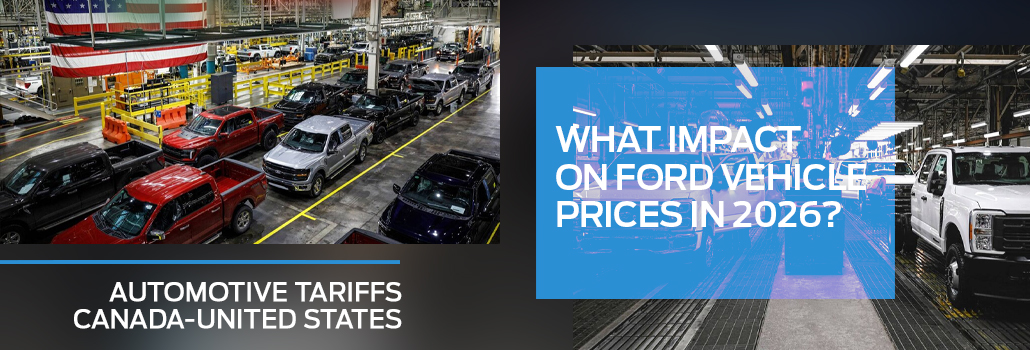
In 2026, automotive tariffs between Canada and the United States remain a major issue for the North American automotive industry. Following the initial trade tensions and measures announced in previous years, a new possibility is drawing particular attention: the potential imposition of U.S. tariffs of up to 50% on automobiles and parts manufactured in Canada.
For drivers in Châteauguay, Mercier, Léry, Beauharnois, Kahnawake, Sainte-Catherine, La Prairie and Montreal’s South Shore, the issue is much more concrete than a simple trade debate: could these tariffs increase the price of a 2026 Ford F-150, a 2026 Ford Super Duty, a Ford SUV or another new vehicle in 2026?
The answer requires some important nuance.
A tariff announced at 25%, 50% or any other rate does not automatically mean that a vehicle sold at a dealership will cost 25% or 50% more. The impact depends on where the vehicle is assembled, where its components come from, the market for which it is intended, the applicable trade rules and the decisions made by the manufacturer.
For a Quebec buyer, the best way to assess the situation is therefore to compare vehicles that are actually available. Solution Ford makes it easy to browse its new Ford vehicles as well as its new Ford inventory in Châteauguay.
To understand the potential effect of automotive tariffs in 2026, it is important to first understand how the North American automotive industry operates.
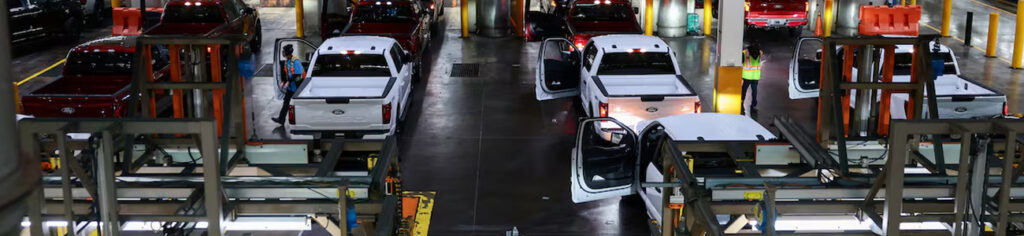
A vehicle sold in Quebec is not necessarily manufactured entirely in one country. An engine may come from one plant, a transmission from another, certain electronic components from a third, while final assembly may take place in Canada, the United States or Mexico.
Parts may also cross the border at different stages of the manufacturing process.
This is why a tariff targeting Canadian automobiles exported to the United States can have an impact that extends well beyond the vehicle directly affected. If supplying the U.S. market from a Canadian plant becomes more expensive, a manufacturer could eventually reconsider production volumes, the origin of certain components or the distribution of production between different plants.
These changes could then affect vehicle availability, manufacturing costs and, over the longer term, the prices charged to consumers.
However, one common shortcut should be avoided: a tariff paid at the border is not automatically added in full to the retail price of a vehicle sold in Canada.
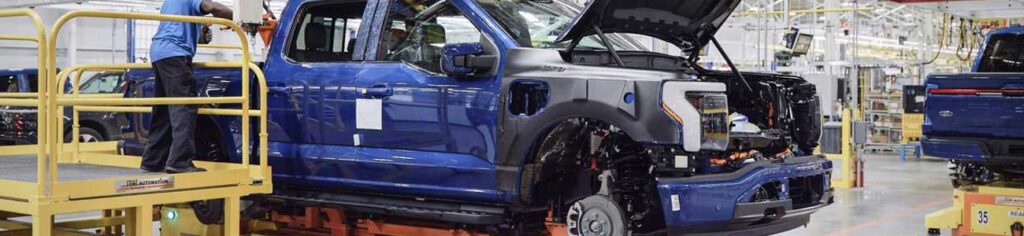
One of the major developments of summer 2026 involves the possibility of another substantial increase in U.S. tariffs.
In an article published on August 28, 2026, Le Guide de l’auto reported that a post by U.S. President Donald Trump raised the possibility of imposing a 50% tariff on automobiles and parts manufactured in Canada and exported to the United States. At the time described by that source, this was a tariff threat rather than a 50% tariff that Canadian consumers would automatically have to pay on their vehicles.
That distinction is fundamental.
If a vehicle manufactured in Canada and intended for the United States were subject to a significant additional tariff when entering the U.S. market, the economics of that export would be affected first. The manufacturer would then need to determine how to distribute the additional cost, adjust production or modify its supply chain.
For buyers in Châteauguay and Montreal’s South Shore, the potential effect could therefore be indirect before becoming visible on a vehicle’s price tag.
Ford provides an excellent example of the integration between the Canadian and U.S. markets.
According to the same source, Ford was expected to restart vehicle production at its Oakville, Ontario plant in fall 2026 after approximately three years of inactivity. The facility is expected to participate in the production of 2026 Ford Super Duty trucks in response to demand.
This decision takes on particular importance in the current tariff environment.
The 2026 Ford Super Duty is a strategic vehicle line for Ford, particularly among contractors, businesses and drivers with significant towing or payload requirements. Because part of this Canadian production is intended for the North American market, a substantial tariff barrier at the U.S. border could alter the economics surrounding that production.
That does not mean a 2026 Ford Super Duty sold in Quebec would automatically become 50% more expensive.
A truck intended for the Canadian market does not necessarily follow the same trade route as a vehicle manufactured in Canada and exported to the United States. However, if tariffs change production volumes, sourcing costs or the allocation of vehicles between markets, there could eventually be consequences for pricing or availability.
For customers interested in a pickup truck or another Ford vehicle, reviewing Ford manufacturer offers alongside currently available vehicles is therefore a much more practical approach than attempting to convert an announced tariff directly into a vehicle price increase.
The debate does not concern complete vehicles alone.
Canada also has a major automotive parts manufacturing industry. The source provided notes that many Canadian companies manufacture components required for vehicle assembly and that a 50% tariff on these exports would have significant consequences for suppliers.
For Ford, as for other manufacturers, this aspect is crucial.
A component manufactured in Canada can be shipped to a U.S. plant and installed in a vehicle that is later sold in Canada. A tariff on that component could therefore increase the production cost of a vehicle even if the vehicle itself is assembled in the United States.
Conversely, an American-made part may be used in a vehicle assembled in Canada.
This constant movement of engines, electronic components, transmission parts, body materials and other equipment is what makes the effect of tariffs particularly difficult to predict.
A buyer should therefore pay closer attention to the actual price evolution of the vehicle they are interested in rather than focusing solely on the tariff rate announced in the news.
| Affected Element | Possible Situation in 2026 | Potential Effect on Ford | Possible Effect for Quebec Buyers |
| Vehicle assembled in Canada and exported to the United States | Tariff threat of up to 50% according to the August 2026 source | Higher export costs and pressure on production strategy | Possible indirect impact on volumes, allocation or costs |
| Automotive parts manufactured in Canada | Possibility of high tariffs when entering the United States | Potential increase in the cost of certain components | Possible impact on manufacturing costs |
| 2026 Ford Super Duty produced in Oakville | Restart of Canadian production expected in 2026 | Canadian production becomes more exposed to cross-border trade conditions | Availability and pricing to monitor depending on market conditions |
| Vehicle already in inventory in Quebec | Vehicle physically available at the dealership | Less uncertainty regarding immediate availability | Actual price is easier to compare |
| Vehicle to be manufactured or ordered | Future production subject to changing market conditions | Costs and availability may change | Delivery time and final price should be confirmed |
| Pre-owned Ford vehicle | No automatic link to a new customs tariff | Value influenced primarily by supply and demand | May become an alternative to buying new |
This table shows why the impact of automotive tariffs in 2026 cannot be summarized with a simple formula such as “50% tariff = vehicle costs 50% more.”
Consider a simple example.
If a tariff applies to a Canadian vehicle exported to the United States, it is that cross-border transaction that is directly affected. A Ford purchased in Châteauguay and remaining in the Canadian market does not necessarily follow the same route.
Even when a tariff does directly affect a vehicle or some of its components, several factors determine how much of that cost may eventually appear in the retail price.
Ford could change the origin of certain parts, reorganize production, distribute some of the costs across different markets or adjust its sales incentives. Vehicle availability also plays an important role.
This is why browsing the new Ford vehicle inventory can be particularly useful during a period of tariff uncertainty. A vehicle that is already available allows buyers to work with a known price and configuration rather than relying on assumptions about what a future production vehicle may cost.
Ford is not the only manufacturer affected by the integration of the Canadian and U.S. markets.
The Guide de l’auto article notes that Honda and Toyota also manufacture vehicles in Ontario and states that more than 80% of this production is exported to the United States.
This figure illustrates just how dependent the Canadian market is on cross-border trade.
Even when a consumer purchases a vehicle just a few kilometres from home in Châteauguay, the manufacturing chain behind that vehicle may span several regions and cross multiple borders.
In 2026, the tariff issue is therefore not simply about the price of imports. It also affects investment decisions, parts suppliers, production volumes and the future of certain Canadian manufacturing plants.
For a Solution Ford customer, the main concern remains price.
In the short term, it would be unwise to conclude that all Ford vehicles will experience a uniform price increase because of tariffs. Some models and configurations may be more exposed to cost changes than others.
The final price also depends on the selected trim, equipment, powertrain, available promotions and financing.
A buyer in Mercier looking for a work truck will not necessarily face the same considerations as a family in Châteauguay shopping for an SUV. A driver in Beauharnois who travels many kilometres may place greater importance on operating costs and the type of powertrain.
Different Ford technologies can also influence purchase price, particularly when comparing conventional, hybrid and electric powertrains depending on the models available.
Yes, promotions can play an important role in the actual cost of acquiring a vehicle.
Even in a market facing tariff pressure, manufacturers continue to adjust their programs based on demand, inventory levels and model years.
As a result, a rebate, manufacturer program or local promotion may sometimes partially offset other price increases.
For this reason, it can be worthwhile to review Solution Ford’s Door Crasher Deals before comparing suggested retail prices alone.
A test drive then gives buyers the opportunity to determine whether a vehicle truly meets their needs before making a decision based solely on price or tariff-related news.

The pre-owned market may also be affected indirectly.
If certain new vehicles become more expensive or less available, more consumers may turn to pre-owned vehicles. Increased demand could then place upward pressure on used-vehicle values.
However, once again, nothing is automatic.
Local availability, mileage, vehicle condition, model year and history remain key factors. Solution Ford’s pre-owned vehicle inventory allows buyers to directly compare these options with available new vehicles.
For an owner considering replacing their current vehicle, market uncertainty can also make trade-in value especially important. A trade-in vehicle evaluation can help determine its current value and include it in the calculation for the next purchase.
A change of a few thousand dollars in the price of a vehicle does not affect every buyer in the same way.
The down payment, loan term, interest rate, trade-in value and promotional programs can significantly change the final payment.
That is why it is preferable to evaluate the vehicle price together with the available automotive financing options at Solution Ford.
For drivers whose credit situation requires a different approach, 2nd and 3rd chance credit financing solutions are also available.
In an automotive market as changeable as the one in 2026, the actual payment and total financing cost are often more useful to compare than a simple variation in the vehicle’s retail price.
The question is legitimate, but no one can guarantee that waiting will necessarily result in a better price.
Trade policies can change quickly. The 50% tariff threat discussed in August 2026 demonstrates just how quickly the situation can evolve.
Waiting could make it possible to take advantage of a new promotion or a favourable change. On the other hand, a configuration currently available could disappear from inventory, or production costs could change.
For buyers in Châteauguay, Mercier, Kahnawake, Léry or Montreal’s South Shore, a practical approach is to compare what is actually available today, the applicable programs and financing costs rather than attempting to predict the next trade-policy decision with certainty.
Buyers who are hesitating between several models can browse new Ford vehicles or contact Solution Ford to compare the configurations currently available.
The source provided, published on August 28, 2026, discusses the possibility of a 50% U.S. tariff on automobiles and parts manufactured in Canada. It does not describe this rate as an automatic price increase already being applied to every vehicle sold in Canada.
No, not automatically. A tariff applied to a cross-border transaction is not equivalent to an identical increase in the Canadian retail price. Its effect depends on factors including the vehicle involved, where it is assembled, where its parts come from and the decisions made by the manufacturer.
Ford plans to restart automotive production in Oakville, Ontario, including production of 2026 Ford Super Duty trucks. Canadian production intended partly for the North American market can be sensitive to tariffs imposed on exports to the United States.
A vehicle already in inventory has the advantage of a known price and availability. Future tariffs therefore do not automatically mean its price will change. However, applicable sales conditions and promotions should always be confirmed at the time of purchase.
Yes, potentially. Canada’s automotive industry manufactures many parts used throughout North American production chains. Tariffs on these components can change manufacturing costs even when the complete vehicle is not directly targeted.
Possibly, but it depends on the market. If new-vehicle prices or availability change, demand for pre-owned vehicles may also evolve. Buyers should therefore compare the actual price, mileage, condition, warranty and financing options of both new and pre-owned vehicles.
The most reliable approach is to check a specific vehicle, its trim, equipment, applicable promotions, your trade-in value and financing conditions. Tariff-related news can help explain the market, but it does not replace a quote based on a vehicle that is actually available.
Trade tensions between Canada and the United States are adding another important variable to the automotive market in 2026.
The possibility raised in August of a U.S. tariff of up to 50% on vehicles and parts manufactured in Canada shows that significant uncertainty remains. In Ford’s case, the planned restart of the Oakville plant for 2026 Ford Super Duty production directly illustrates how U.S. trade decisions can have consequences for Canada’s automotive industry.
For drivers in Châteauguay and Montreal’s South Shore, however, it is important not to translate an announced tariff rate directly into an equivalent increase in the price of a vehicle.
The actual cost of a Ford depends on many more factors: manufacturing location, components, availability, trim, equipment, promotions, financing and trade-in value.
In such a rapidly changing environment, comparing vehicles that are actually available remains the best way to obtain a clear picture of the market. You can browse Solution Ford’s new Ford inventory, book a test drive or contact the Solution Ford team in Châteauguay to learn more about current pricing and programs applicable to the vehicle you are interested in.